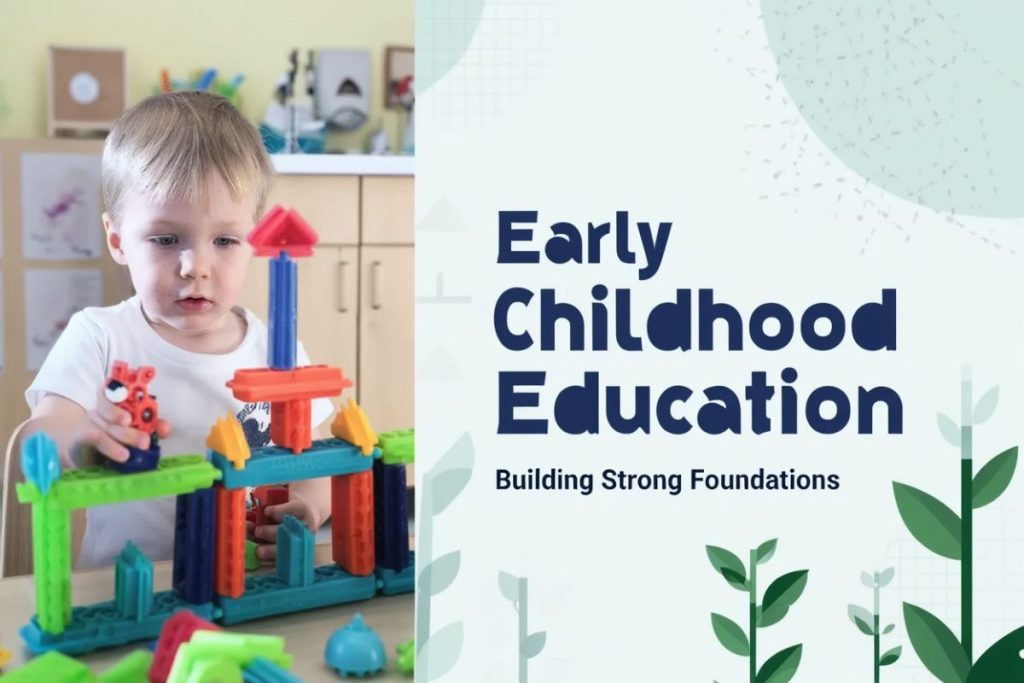
Early childhood educations (ECE) is widely recognized as the cornerstone of lifelong learning and development. During the first five years of life, up to 90% of a child’s brain development occurs, making early learning experiences critically important. Quality early learning environments leverage this critical period to build “the foundation for good health, nutrition, learning success, social-emotional development, and economic productivity throughout life.”.
In fact, access to quality ECE “matters for building a strong foundation and flourishing throughout life”. In short, investing in young children yields strong returns: they gain language, social, and thinking skills earlier, and societies benefit through healthier, more productive adults.
-
Vast developmental gains: By age five, children absorb language, social rules, and basic concepts at a remarkable rate. Early education makes use of this plasticity to teach letters, counting, social skills, and more, giving children a head start.
-
School readiness and equity: High-quality ECE promotes school readiness and narrows gaps. Research shows it “boosts children’s school readiness and reduces the gap between socially advantaged and disadvantaged children”. If all children have access, the playing field evens out at the start of elementary school.
-
High return on investment: Economists estimate that every dollar invested in effective ECE yields multiple dollars in future benefits. One UNESCO analysis reports a ~13% annual return through improved health and economic outcomes. Other studies find $4–$12 of social benefit for every $1 spent on preschool.
Why Early Childhood Educations Matters?
The period from birth through age five is a remarkable window of opportunity. Neuroscience shows that early experiences literally shape the brain’s architecture: they can create either strong neural foundations or leave lasting gaps. When children are healthy, safe, and learning during these years, they are far more likely to reach their full potential. In contrast, lack of stimulation or poor learning environments can put children on a weaker trajectory that is harder to reverse. UNESCO warns that “inequalities start early and persist throughout life” if quality learning is missing.
Early childhood educations also has broad social benefits. By enrolling all children regardless of background—in quality programs, societies can narrow achievement gaps and promote social mobility. UNESCO explicitly links ECE to equity and social justice, calling it a means to close the socioeconomic divide. Empirical evidence supports this: participants in preschool programs tend to have better outcomes as teenagers and adults, including higher test scores, higher graduation rates, and higher earnings. In fact, a major review of early-learning experiments showed that children who attended strong ECCE programs were less likely to engage in crime and more likely to hold steady jobs as adults.
The importance of early learning is also clear from its economic impact. In the United States, one analysis estimates that the shortage of affordable infant and toddler care costs the economy about $122 billion per year in lost earnings and productivity. This loss arises when parents (often mothers) must reduce work because childcare is unaffordable. Improving ECE systems helps families and economies both: more parents can work, and future taxpayers are saved from greater costs in remedial education or social services.
In short, early childhood educations is not just “pre-school” – it is a powerful investment. It fosters cognitive and social skills, reduces future costs, and lays a foundation that benefits all of society.
Key Components of Effective Early Education:
Building a strong foundation in the early years requires well-designed programs. UNESCO and education experts agree that the quality of ECE is defined by several key elements. Programs should combine skilled, nurturing teachers with developmentally appropriate curricula and supportive environments.
A young girl engaged in a creative music activity, illustrating play-based learning in early childhood educations. This snapshot of a preschool activity shows how play is an essential part of strong early education. Through creative play—such as setting up a pretend “Music Centre” children explore concepts and language in a joyful, hands-on way.
-
Qualified, Caring Educators: Teachers and caregivers should be trained in child development. Research notes that investing in teacher training leads to safer and more stimulating classrooms. Skilled educators can tailor activities to children’s needs and provide the warm guidance young learners require.
-
Play-Based Curriculum: Young children learn best through play and exploration. The curriculum should include games, songs, art projects, and storytelling that encourage creativity, problem-solving, and collaboration. Research shows that this play-based approach is linked to development of 21st-century skills (like communication, critical thinking, and creativity) and strong gains in language and math. For example, hands-on activities like building blocks or art projects help children develop motor and cognitive skills, while group games build social skills.
-
Rich Learning Environment: Classrooms must have a variety of age-appropriate materials—books, blocks, art supplies, puzzles, etc.to spark curiosity. Simple items like alphabet charts or counting games reinforce learning of letters and numbers. Basic supports are also important: UNESCO stresses the need for adequate facilities (clean water, sanitation, nutrition) to support children’s health and readiness.
-
Family and Community Engagement: Effective programs involve parents and the broader community. Policies like paid parental leave, childcare subsidies, and parent-education programs help integrate home and school learning. For example, some centers invite parents to volunteer or share cultural traditions. When families reinforce ECE activities at home (e.g., reading bedtime stories), children benefit from consistent learning.
-
Inclusive Practices: High-quality ECE reaches all children, including those with disabilities or from minority backgrounds. Differentiated instruction and extra support ensure every child can participate. Studies show that early inclusion helps close achievement gaps: children who receive early intervention for learning delays often catch up to peers by the time they enter primary school.
These elements create the conditions for effective learning. Programs that excel in these areas (small class sizes, rich curricula, professional teachers, strong community ties) consistently yield better outcomes for children.
Benefits of Quality Early Childhood Educations:
Quality early childhood education yields tangible benefits for children, families, and society. Children who attend strong ECE programs exhibit higher cognitive and academic skills. They start kindergarten with larger vocabularies and stronger numeracy. Educators report that these children adapt more quickly to classroom routines and can focus on learning, since basic skills are already in place.
Equally important are social-emotional gains. In preschool, children learn to share, take turns, and solve conflicts. They build empathy by interacting with peers, and they gain confidence by mastering new tasks. These early social skills reduce behavior problems later. In fact, long-term studies have found that participants in high-quality ECE show fewer behavioral issues in adolescence than similar children who did not attend preschool.
The economic and societal returns are equally impressive. Classic experiments (like the Perry Preschool and Abecedarian projects) showed participants were more likely to finish high school and hold stable jobs as adults. One summary of decades-long research found that early interventions “reduced crime, improved educational attainment, boosted cognitive development, increased employment, and improved health.” The financial payoff is seen in reduced spending on social services: participants also yielded about $2.50 in future savings for every $1 initially invested in their preschool program.
In addition, strong ECE can improve health outcomes. Programs often include health screenings and nutrition guidance. There is evidence that children who attend preschool programs have higher immunization rates and better developmental monitoring. Early intervention can even help mitigate adverse experiences: one World Bank study found that severely malnourished children in Jamaica who received quality early stimulation earned 25% higher wages as adults than similarly malnourished peers who did not. This illustrates how early education can help disadvantaged children “catch up.”
Some specific benefits of quality ECE include:
-
Improved Learning Skills: Children learn foundational literacy and numeracy. They pick up letters, sounds, counting, and pattern recognition through games and structured lessons. This head start makes formal schooling easier and more enjoyable.
-
Better Socialization: Regular interaction with teachers and peers helps children develop friendships and communication skills. They practice patience, independence, and resilience. Teachers often note that school-ready kids from good preschools adapt more easily to new learning challenges.
-
Greater Long-Term Achievement: Multiple studies link preschool attendance to higher grades and test scores later on. For example, students who attended preschool are more likely to graduate high school and pursue college. A recent analysis found that any level of early schooling improved literacy by third grade, showing sustained academic gains.
-
Economic Gains for Families: Access to reliable ECE allows more parents to work or pursue training, increasing family income. It also reduces expenses on informal childcare. When combined across society, this can boost productivity – as seen in the U.S., where affordable childcare policies would recoup billions by raising adult earnings.
In summary, early childhood education creates a virtuous cycle: children benefit immediately in learning and health, and those benefits compound over time. By building skills early, society reduces future costs and fosters a stronger workforce.
Supporting Early Learning at Home
Education doesn’t end at the school door. Parents and caregivers play a vital role in reinforcing early learning. Simple, everyday interactions can continue the learning process. For instance, reading books aloud or telling stories exposes children to rich language and vocabulary. Pediatric research consistently finds that children who grow up with lots of verbal interaction and reading have stronger early literacy skills.
It’s also been noted that a stimulating home learning environment makes a big difference. UNESCO data shows about 64% of children globally have a positive home learning setting. This includes having books or educational toys at home and parents who engage in learning activities with their children. In wealthier families, about 78% of children are developmentally on track, versus only 55% in the poorest households.
Parents can encourage learning with everyday activities. Here are some practical tips:
-
Talk Through Activities: Describe what you are doing when cooking, shopping, or traveling. For example, count steps while walking or identify colors of cars. This teaches vocabulary and basic math concepts.
-
Read Together Daily: Even a few minutes of reading can spark a love of stories. Point at pictures, ask your child to guess what happens next, and relate stories to things your child experiences. This fosters early literacy and listening skills.
-
Encourage Play and Exploration: Provide blocks, puzzles, or art supplies and give your child time for unstructured play. This nurtures creativity, problem-solving, and confidence.
-
Set Consistent Routines: Regular meal and sleep schedules give children a sense of security, which is important for learning readiness. During meals or bath time, chat with your child about their day.
-
Use Community Resources: Take advantage of libraries, playgroups, and child-friendly events. Story hours at the library, family nights at museums, or community music classes expose children to new experiences and social learning.
By embedding learning in daily life, parents dramatically extend the reach of formal ECE. Such home support has been shown to reinforce skills gained in school and can equalize outcomes. In fact, communities where families and teachers work together, early education programs have an even greater impact.
Policy, Investment, and Global Initiatives
Recognizing the importance of the earliest years, governments and international bodies have put early education on the agenda. The United Nations’ Sustainable Development Goal 4.2 explicitly calls for all children to have access to quality pre-primary education by 2030. Yet many countries are not on track: UNESCO notes that nearly one-quarter of five-year-olds worldwide have never attended any pre-primary program. Achieving SDG 4.2 will require large investments in teachers and infrastructure.
UNESCO’s Global Report on ECCE estimates that low- and lower-middle-income countries need an additional US$21 billion per year just to reach 2030 targets. They would also need to recruit “at least six million more educators” by 2030, highlighting the scale of the challenge.
Some nations are already taking action. For example, Uzbekistan dramatically expanded enrollment: in 2017 only 27% of its children had early schooling, but recent reforms raised that to about 75%. Many countries in Europe and East Asia now guarantee one or two years of free preschool. Others are piloting universal pre-K programs. International initiatives also provide guidance: UNESCO recommends that governments allocate at least 10% of education budgets to early learning. The World Bank emphasizes an integrated approach: its Early Years framework links early education with health and nutrition interventions to maximize impact. The recent Tashkent Declaration (2022) and various global partnerships call on governments to treat early learning as a right and integrate it across sectors.
In some places, social welfare programs are being tied to early education. For example, Brazil’s Bolsa Família conditional cash transfer program links benefits to children’s health check-ups and school attendance. This policy encourages parents to invest in their children’s development from infancy, showing how education can be part of broader anti-poverty strategies.
Ultimately, experts agree: investing in young children is an investment in the nation’s future. When governments treat early education as a priority in policy and budgets, they lay the groundwork for a more skilled and equitable society.
Challenges and Opportunities:
Despite growing awareness, hurdles remain. Access and equity are major issues. In rich countries, preschool participation might exceed 80%, but in low-income countries it can be well below 30% . Even within countries, disparities by income or region can be stark. Globally, over 175 million children under age 6 receive no early learning or childcare at all . Many are the world’s most vulnerable children, who need support the most.
Funding is another obstacle. UNESCO reports many governments spend only a tiny fraction of GDP on ECE (the global median is about 0.4%). By comparison, OECD countries average around 0.8%. This underinvestment means that in many places, preschools lack basic facilities or operate on a small scale. Improving quality is hard when teacher salaries are low and training opportunities are few. In fact, UNESCO warns that to meet global goals, countries will need to recruit six million more early educators by 2030.
Emergencies can also derail progress. The COVID-19 pandemic showed how fragile ECE systems are: UNESCO estimates that school closures resulted in nearly 19 billion person-days of lost ECCE instruction worldwide. Many young children missed vital stimulation and social interaction during that time. Recovering from such losses requires new strategies, such as catch-up programs and remote learning support for families.
However, each challenge also points to an opportunity. Research highlights clear strategies for improvement: increase public funding, professionalize the workforce, and leverage cross-sector collaboration. For example, some countries are expanding caregiver training programs and aligning health checkups with developmental screenings. The use of data is improving: more governments are monitoring child outcomes so they can target resources where needs are greatest.
Innovation is also key. Many successful programs now integrate services: health workers deliver early learning games during home visits, mobile apps provide literacy games for families, and community centers offer combined daycare and nutrition services. By weaving early education into broader social systems, these models can reach more children effectively.
In summary, the challenges are real, but so are the solutions. With sustained investment and smart policies, every child can access the enriching early experiences that build a strong foundation. As UNESCO notes, “The call to transform education must begin with the youngest children.” Ensuring that call is answered will produce benefits that last a lifetime.
Conclusion
Early childhood education is much more than child care – it is an essential investment in our collective future. By laying a strong foundation in the early years, we equip children with the skills and confidence they need to thrive. The research is clear: quality ECE boosts learning, narrows gaps, and leads to better outcomes for individuals and society.
Parents, educators, and policy-makers all have a role to play. Families reinforce learning at home through everyday interactions. Schools and teachers provide nurturing, engaging curricula. Governments and NGOs ensure adequate funding, oversight, and support. When these elements work together, every child can benefit from a world-class start to education.
In practice, this means using data to guide action and sharing what works. Some preschools now use simple checklists to monitor developmental milestones, allowing educators to tailor activities. Teachers collaborate by sharing playful lesson plans and innovative methods at conferences and online forums. Community institutions contribute too: public libraries and community centers host free story hours, parenting workshops, and educational playgroups. By combining data-driven practices with community-driven support, we continuously improve quality. When parents, teachers, and official policy-makers align on early learning priorities, we truly build a stronger generation.
Share this article on social media or with others who care about children’s futures. Early childhood educations impacts us all, and by building strong foundations today, our entire society will reap the rewards tomorrow.
Frequently Asked Questions (FAQs)
Q: What is early childhood education?
A: Early childhood education refers to structured learning experiences for very young children (typically from birth through age 8, before primary school). This includes preschool, kindergarten, and other programs that use play, exploration, and guided activities to teach basic skills (like numbers, letters, and social habits). The goal is to prepare children for formal schooling and life.
Q: Why is building a strong foundation in early childhood so important?
A: Because the brain develops most rapidly in the first years of life, positive experiences during this time have a lasting impact. Early childhood education ensures children learn key skills — language, motor, and social skills — while they are most ready for them. Children who receive quality ECE enter school more prepared, making it easier for them to succeed. Without this strong start, children may struggle more later on.
Q: What are the key benefits of early childhood education?
A: Quality early education offers many benefits. It helps children develop cognitive skills (like counting and storytelling) and social skills (like sharing and empathy). It also builds routines of learning and confidence. In the long term, it leads to higher graduation rates, better jobs, and improved health outcomes. Economically, every dollar spent on ECE saves multiple dollars later on (by reducing costs for remedial education and social services).
Q: How can parents support learning at home?
A: Parents can reinforce ECE by engaging in simple daily activities: read stories or sing songs with your child, talk and describe what you’re doing, play counting or language games, and encourage pretend play. Providing books and educational toys, and maintaining a consistent routine (sleep and mealtimes), also helps a child feel secure and ready to learn. These small actions reinforce what children learn in preschool.
Q: What should I look for in a quality early education program?
A: A good program has well-trained, caring educators and a low child-to-teacher ratio. Look for classrooms with lots of books, art supplies, and play materials. The curriculum should be rich in play and exploration, not just rote drills. Family involvement (like parent-teacher communication and family activities) is also important. Finally, a safe and inclusive environment where each child’s needs are respected is essential for true quality.
Q: How does early childhood education benefit society as a whole?
A: Societal benefits include a more skilled future workforce, higher productivity, and lower social costs. Children who start school ready to learn need fewer special services and are less likely to drop out of school. This leads to a stronger economy and less crime. UNESCO and economists agree that investing in young children accelerates economic growth and social equity over the long term.
Q: At what age does early childhood education begin?
A: Early childhood education can start from birth, since even infants benefit from learning through play and interaction. Some programs (such as infant-toddler centers) focus on babies and toddlers. Formal preschool typically begins around ages 3–4. The key point is that children should have supportive, language-rich experiences as early as possible, because their brains develop rapidly in those first years.
Q: How do governments support early childhood education?
A: Governments can make ECE accessible by funding and regulating programs. For example, they may provide free or subsidized preschool for all children, set quality standards for curricula and teacher training, or include early education in compulsory education laws. Some offer grants or vouchers to low-income families. By allocating public budgets to pre-primary schooling and childcare, governments ensure that early learning is regarded as part of every child’s right to education.
Previous Post: American College of Education Programs